Seeing Like a State by James C. Scott - From Authoritarian Forestry to Digital Identity
What I took away from Seeing Like a State by James C. Scott

I like books. I like books that make me look at the references and grow my to-read list. Recently, I’ve read Seeing Like a State by James C. Scott and had a great time with it. I’ve learned a great deal about Soviet history, architecture, and poly-cropping farming. This piece is a summary of my takeaways and how some aspects of the book relate to contemporary digital projects.
Schemes to Improve the Human Condition
Seeing Like a State is dubbed How Certain Schemes to Improve the Human Condition Have Failed. This immediately sets the stage for a book whose main argument is that centralization and top-down planning lack certain desirable attributes and this is indeed what most of the book is about.
All the cases Scott studies involve important commonalities: a desire to simplify complexity, and a will to start over – discarding existing methods, customs, or even entire cities. The sheer magnitude of the plans exposed through the book makes them almost inevitably state-backed and reliant on enforcement by law, bureaucracy, or violence. At the root of these projects, of special interest to me as someone working in technology, is what Scott calls high-modernism, a faith in the ability to transform and improve society through rational and technical means.
On Legibility and the Intelligence It Destroys
The Four Horsemen of the High-Modernist Apocalypse
Scott identifies four element that create fertile ground for the projects analyzed in the book. I call them the four horsemen of the high modernist apocalypse, they are:
- The administrative ordering of nature and society: a set of simplification made in the name of easier understanding
- A high-modernist ideology: a deep faith that technology and rationalism can lift populations and help the state.
- An authoritarian state: I’ll let you pick your own examples.
- A prostrate civil society: a population that is either passive or lacks the mean to resist the high-modernist plans
Note that Scott does not imply all these elements always need to be present. Most of them can be placed on a spectrum.
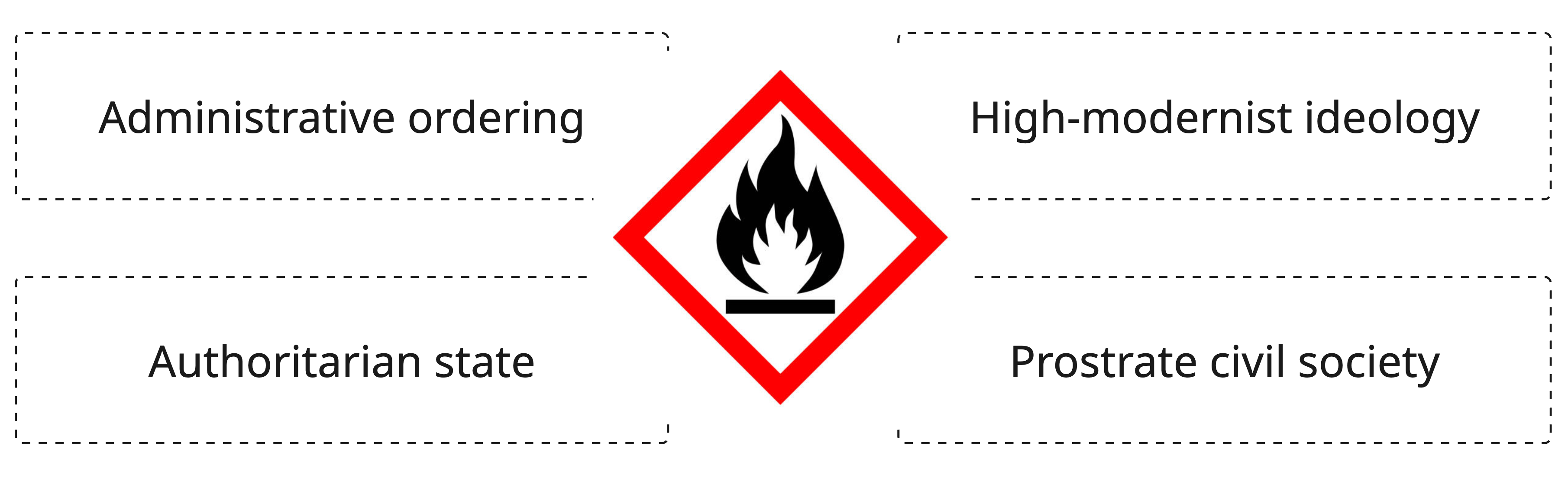 Ingredients for a high-modernist combustion
Legibility: Making the World Readable
Legibility is at the core of many of the projects in the book and key to the “administrative ordering” concept. It is a simplification made in the name of easier understanding and control. Some of Scott’s examples are:
- Forest organization - to simplify logging taxes
- Fixed names - to simplify property taxes
- Cadastral redrawing - to simplify land area taxes
This isn’t to say taxation itself is unjustified, but focusing a model on a single output drives optimizations that sideline other desirable but less measurable outputs. Modeling reality is a daunting task. As such, it demands simplifications – with various consequences.
When assigning fixed names to the Filipino population, the Spanish occupants assigned each district a few letters of the alphabet with which names in the district were to start, resulting in a completely unnatural distribution of names in the population. Benign (?).
When planning forests for easier taxing, states modeled - and thus created - single-essence forests resulting in drastically diminished yields after the forest ecosystem collapsed, compromising the long-term health of the environment. Disastrous.
In Ethiopia, displaced populations with highly contextual knowledge were dropped in a grid system of fields to be exploited according to a state-provided plan — resulting in a poor farming performance carried out by a discontent and riotous population.
Legibility, with its drastic simplifications, erodes an enormous amount of generational knowledge encoded in a collective, practical, behavioral intelligence. This intelligence is highly specialized and tied to local conditions; it is the small arrangements and flexibility that made some systems viable in the first place. In enforcing a new order, legibility sweeps away what Scott identifies as the foundation of all functional, humane societies: metis.
Scaling without Knowing: The Loss of Metis
Multiple facets of agriculture are scrutinized throughout the book. The conclusion is always the same: broad agricultural planning schemes fail to deliver on the promises of abstract rationalization. The very premise of these abstractions is flawed when detached from local knowledge. Their sophistication is irrelevant if their epistemic foundation is broken: these models are blind by design. Some believe that experience in clean and simple monocrop farming can be systematically applied to surpass the yields of messy poly-cropping and adaptive farming techniques employed in other places. Some think economy of scale and private capital are guaranteed to outperform the small-scale operations of family farms.
In each of the portrayed projects – whether in USSR kolkhozy, US large-scale agricultural reforms and state incentives, or Ethiopian displacement and planning of the farming workforce and their crops, the result is clear: scaled-up agriculture fails to rival the flexibility and engagement of small family farms. They often falls short in delivering high yields, adaptability to weather and climate, and long-term viability (both ecological and cultural).
For Scott, these are all prime examples of the main shortcoming of high-modernism: the loss of metis. He uses the ancient Greek word for “cunning intelligence” and “skill” to describe the collective and highly situational knowledge that develops in communities where members can act as free agents and work to improve their situation.
Metis, or loss thereof, explains why kolkhozy farmers had neither the incentives nor the freedom of action to meet or exceed the extravagant targets set by Lenin. Metis allowed U.S. farmers to drastically minimize cost and optimize yields by combining intimate knowledge of their land with flexible family labor throughout the year. Metis is how Ethiopian farmers developed poly-cropping techniques that allowed them to create a food surplus even in adversarial conditions. But these results are tightly bound to the local knowledge of each family.
My most important takeaway from Scott’s argument is that organizations seeking to increase their output should not focus on maximizing yield directly, but on maximizing their members’ agency. Since it is hard to measure and control, this agency is often among the first things lost in optimization efforts driven by rational models, leaving actors without proper incentives or tools to improve their own situation. Scott argues that central control loses sight of on-the-ground reality, alienating locals from their own environment. In this, models show their worst flaw. I’d add that such disconnection distorts people’s very perception of their environment – erasing shared understanding of reality, fatally undermining decision-making, and severing any meaningful feedback channel between reality and model.
Caveats and Modulations
There are a few caveats to address about the book’s content that are useful hinges to pivot or enrich the discussion.
Some have criticized Seeing Like a State for having hand-picked a few case studies that matched the author’s thesis. I don’t think this invalidates Scott’s analysis – one that is never touted as universally true. Nonetheless, careful readers will want to balance that reading with one more in favor of centralization and top-down planning – I’m open for suggestions.
There’s also a case to be made for some of the projects: they may have been badly executed, but they replaced a worse status quo.
Scott himself, in the book, makes a case for centralized authority in order to avoid the tragedy of the commons by coordinating the use of said commons. His argument centers more on the methods employed than on the will to improve or change things by a centralized power.
Digital Technologies: Same but Different
It is not hard to see echoes of Scott’s cautionary tales in today’s digital planning ambitions. The belief that complex systems can be rationalized, simplified, and their effectiveness amplified is thriving in tech circles, and the idea is not new. State-level digital policies and the current political discourse around digital sovereignty inevitably recall Allende’s vision for Chile: an independent socialist democracy powered by cybernetics – essentially a computer-enabled push for large-scale legibility. This is very well documented by Evgeny Morozov in his podcast The Santiago Boys.
Technology often has a seductive pull of legibility, optimization, and top-down control. It often blurs the line between the desire for efficiency and political ideal. One of the lenses to analyze the impact of technology is the statement “the purpose of technology is what it does”, coined by Stafford Beer, who was leading Chile’s cybernetics effort. But many seem not to like the messy bag of issues this entails, or simply sweep it under the rug. By the time the bump becomes inconvenient, nobody will be too keen to look underneath. Because this understanding is teleological, we only recognize a technology’s purpose after it has started reshaping reality. That uncertainty makes it tempting to avoid the discussion altogether. How do we predict what people are going to make of a new technology? Some will understand it deeply, some not at all. Some people will creatively combine it with other tools or adapt it to entirely new contexts. This makes the “what can we do about it anyway” argument appealing, but it also paralyzes meaningful discussion. My point here is that not only are we still trapped in the complexity-erasing way of thinking, we are now doing it with digital technologies. Technologies that spread at extremely high speed, without boundaries, making their impact far and wide, and hard to anticipate.
After years (probably centuries or millennia, but this is not an endeavor for today) of discussions around technology and power, people who speak both code and policy are still rare. And among those who speak both, who is fluent in social science and humanities? Whether from lack of education in one or the other, or lack of appetite for messy debates, the result is the same: those who do participate get to design the system for everyone else, the result often reflecting narrow incentives instead of shared values.
It is in this context that countries and alliances are forging and regulating new technologies with a desire for controlled outcomes – which demands legibility and a view from the top that erases nuances and local impacts. Technologies such as digital identity and digital cash are not neutral upgrades. They are not “just your ID but on your phone. They are bound to reshape numerous social interactions that make up our contemporary metis and were built over long periods of time. How deep the reshaping goes is hard to evaluate, but it is necessary to understand as much as we can before trampling values we didn’t think we needed.
Preserving the messy middle
Scott’s warning focuses less on the authoritarian nature of the states or schemes presented than on the system of thoughts that underpins the logic of their social projects. Today’s digital ambitions, deeply rooted in technology solutionism, often inherit from the same shortcomings. While pushing ahead to roll out new technology and tackling the big problems of interoperability and governance at scale, we must protect the small and the messy, the local and hard to generalize knowledge that makes up the rich fabric of our pluralistic societies, or we may well find ourselves living in highly optimized ruins.